
CJC-1295
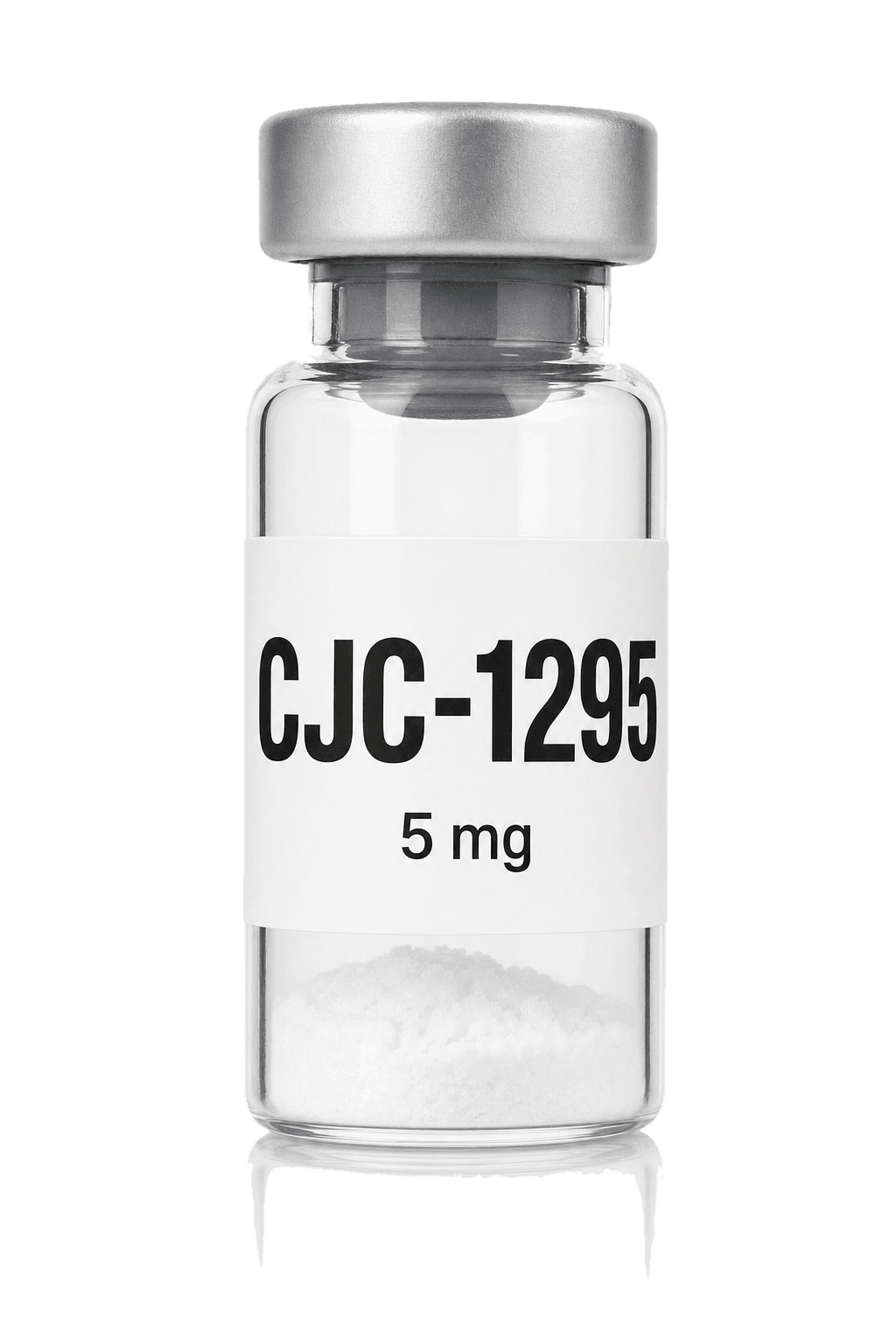
CJC-1295 is a synthetic analog of growth-hormone-releasing hormone (GHRH) studied for stimulating growth hormone secretion. A version with a Drug Affinity Complex (DAC) extends its half-life. It is a research chemical, not an FDA-approved drug.
In plain words
CJC-1295 is a peptide that nudges your body to release more of its own growth hormone. People use it hoping for better muscle, recovery, and sleep. Human safety data is limited.
1 person has this in their stack
Key facts
- Category
- Growth hormone peptides
- Legal / FDA status
- Research chemical (not FDA-approved)
- Half-life
- CJC-1295 with DAC is reported to extend half-life to several days in early studies; the non-DAC version is much shorter (minutes to hours)
- Typical form
- Lyophilized (freeze-dried) powder for reconstitution
- Also known as
- CJC-1295 DAC, Modified GRF (1-29), CJC-1295 without DAC, tetrasubstituted GRF analog
Subcutaneous injection
CJC-1295 is given by subcutaneous injection. The two forms are dosed on very different schedules: the long-acting DAC form roughly once weekly (the form studied by Teichman 2006), and the short-acting no-DAC form (modified GRF 1-29) one to a few times daily. No validated human dose or approved route exists.
Source: Trial/community route — single SC dosing studied for CJC-1295 with DAC (Teichman et al., JCEM 2006). Not FDA-approved.
CJC-1295 is a synthetic analog of growth-hormone-releasing hormone (GHRH) studied for stimulating growth hormone secretion. A version with a Drug Affinity Complex (DAC) greatly extends its half-life. It is a research chemical, not an approved drug, and nothing here is medical advice.
What is CJC-1295?#
CJC-1295 is a synthetic peptide built to mimic growth-hormone-releasing hormone (GHRH), the natural signal that tells the pituitary gland to release growth hormone (GH). By imitating GHRH, it was designed in pharmacology research to raise GH and downstream IGF-1 levels. It is sold as a freeze-dried research chemical and has not been approved as a medicine.
What is the difference between CJC-1295 with and without DAC?#
This is the most important distinction with CJC-1295, because it changes how long the peptide stays active.
| CJC-1295 with DAC | CJC-1295 without DAC (Modified GRF 1-29) | |
|---|---|---|
| Key feature | Drug Affinity Complex binds blood albumin | No albumin-binding complex |
| Reported half-life | Several days | Minutes to a few hours |
| Effect profile | Sustained GH elevation ("bleed") | Short, pulse-like GH release |
| Research interest | Long-acting GHRH analog | Closer to natural GH pulsatility |
The DAC version aims for prolonged GH elevation, while the non-DAC version is short-acting. Neither is an approved therapy.
How does CJC-1295 work?#
CJC-1295 binds GHRH receptors on the pituitary and stimulates growth hormone release; the DAC variant additionally binds albumin so it circulates far longer. These mechanisms are drawn from early pharmacology studies and do not establish a validated human protocol. A licensed clinician is the appropriate person to interpret what this could mean for any individual.
Why is CJC-1295 often discussed with ipamorelin?#
In research literature, CJC-1295 is frequently paired in discussion with ipamorelin because they act through complementary pathways: CJC-1295 mimics GHRH, while ipamorelin works through the ghrelin receptor. Combining substances increases unknowns and potential risk, and any such decision is strictly clinical. WikiPeps does not provide combination protocols.
What is CJC-1295 studied for?#
Early human pharmacology studies measured CJC-1295's effect on growth hormone and IGF-1 levels in healthy adults. Beyond that, it has not been developed into an approved treatment for any condition. Limited human data and the absence of long-term safety studies mean its effects are not well understood.
Is CJC-1295 legal and approved?#
CJC-1295 is not FDA-approved and is not a recognized dietary supplement, so it cannot lawfully be marketed for human consumption in the U.S. It is prohibited at all times in sport by WADA. International rules vary, so confirm local law and consult a licensed professional.
How is CJC-1295 dosed in research?#
There is no validated human dose, and the with-DAC versus without-DAC distinction changes timing considerations entirely. WikiPeps does not publish dosing protocols; dose, frequency, and route are medical decisions for a licensed clinician who knows your history.
How is CJC-1295 reconstituted?#
Lyophilized CJC-1295 is reconstituted by slowly adding bacteriostatic water down the vial wall and swirling gently until clear, as outlined above. Our reconstitution guide and mixing-math guide explain volume selection and unit conversions.
What are the safety considerations?#
Because CJC-1295 acts on a hormonal axis, the unknowns are substantial: long-term effects on the GH/IGF-1 system, interactions with other medications, and risks in people with underlying conditions are not established. The DAC version's long half-life means any effect — wanted or not — persists for days. Research-chemical purity varies. None of this can be navigated safely without a licensed clinician.
The bottom line#
CJC-1295 is a synthetic GHRH analog studied for raising growth hormone, with a long-acting DAC version and a short-acting non-DAC version. It is not FDA-approved, not validated as a therapy, and banned in sport. Use this page for education only and consult a licensed clinician before any health decision.
Side effects & safety
As a growth-hormone stimulator, reported effects mostly relate to raising GH.
Commonly reported
- Water retention / mild puffiness
- Tingling or numbness in the hands
- Head or joint aches
- Flushing or tiredness after a dose
Less common — worth knowing
- Reactive low blood sugar
- More reports with the long-acting DAC form
Human safety data is limited; the long-term effects of sustained GH elevation aren't well studied.
Educational only — not medical advice. Everyone responds differently; talk to a licensed clinician before starting CJC-1295, and stop and seek medical care for any severe or unusual reaction.
Tried CJC-1295, or have a question about it?
Ask the community or share what you noticed — real people doing this carefully. Takes 30 seconds.
How to reconstitute lyophilized CJC-1295 (educational overview)
What you'll need
- Vial of lyophilized CJC-1295 (with or without DAC)
- Bacteriostatic water (or sterile water per product labeling)
- Sterile insulin or reconstitution syringe
- Alcohol prep pads
- Clean, flat work surface
Prepare hands and surface
Wash your hands and wipe down a flat surface. Let both vials reach room temperature before starting.
Disinfect the stoppers
Clean both rubber stoppers with separate alcohol prep pads and let them air dry.
Measure the diluent
Draw the pre-calculated volume of bacteriostatic water. A round number simplifies later dose math — see our mixing-math guide.
Add water against the glass
Let the water run slowly down the inside vial wall rather than directly onto the powder, which helps protect the peptide.
Dissolve gently
Swirl or roll the vial gently until the solution is completely clear. Do not shake.
Label and refrigerate
Label with concentration and date, refrigerate per product guidance, and inspect for clarity before any use.
Frequently asked questions
What is CJC-1295?
- CJC-1295 is a synthetic peptide analog of growth-hormone-releasing hormone (GHRH). It is designed to stimulate the pituitary gland to release growth hormone. It is sold as a research chemical and is not an FDA-approved medicine.
What is the difference between CJC-1295 with DAC and without DAC?
- CJC-1295 'with DAC' includes a Drug Affinity Complex that binds to albumin in the blood, greatly extending its reported half-life to several days. The 'without DAC' version (often called Modified GRF 1-29) is much shorter-acting. The DAC version aims for sustained GH elevation rather than short pulses.
What is CJC-1295 studied for?
- Early pharmacology research examined CJC-1295 for its ability to raise growth hormone and IGF-1 levels. It is not an approved therapy, and human safety and efficacy data are limited.
Is CJC-1295 FDA-approved?
- No. CJC-1295 is not FDA-approved for any use and is sold only as a research chemical. Several peptide growth hormone secretagogues have been flagged by the FDA as unsuitable for compounding.
Is CJC-1295 banned in sports?
- Yes. As a growth-hormone-releasing peptide, CJC-1295 is prohibited at all times in sport by the World Anti-Doping Agency.
Why is CJC-1295 often discussed with ipamorelin?
- They work through complementary pathways — CJC-1295 mimics GHRH while ipamorelin acts on the ghrelin receptor — so they are frequently mentioned together in research literature. Combining substances raises unknowns and is strictly a clinical decision.
How is CJC-1295 reconstituted?
- Lyophilized CJC-1295 is typically reconstituted with bacteriostatic water added slowly down the vial wall and gently swirled until clear. See the steps below and our reconstitution guide.
References
- 1.Prolonged stimulation of growth hormone (GH) and insulin-like growth factor I secretion by CJC-1295, a long-acting analog of GH-releasing hormone — Journal of Clinical Endocrinology & Metabolism (PubMed-indexed) · 2006
- 2.A pharmacokinetic and pharmacodynamic study of CJC-1295 in healthy adults — Journal of Clinical Endocrinology & Metabolism (PubMed-indexed) · 2006
- 3.Prohibited List — Peptide Hormones, Growth Factors (S2) — World Anti-Doping Agency (WADA) · 2024
What the research shows
Early human pharmacology (not approved)CJC-1295 has a real published human pharmacology study: the DAC form produced sustained, dose-dependent rises in GH and IGF-1 in healthy adults. That study established pharmacology, not approved clinical benefit; CJC-1295 is not FDA-approved and there is no validated clinical-use dose.
Prolonged Stimulation of Growth Hormone (GH) and Insulin-Like Growth Factor I Secretion by CJC-1295, a Long-Acting Analog of GH-Releasing Hormone, in Healthy Adults
Teichman SL, Neale A, Lawrence B, Gagnon C, Castaigne JP, Frohman LA · 2006 · J Clin Endocrinol Metab 2006;91(3):799-805 (PMID 16352683)
Citations are real, published sources, graded conservatively. Educational only — not medical advice, and not an endorsement to use any compound.
Improve this page
See something out of date or unclear? Propose an edit — an admin reviews every suggestion before any change is made.
Comments & experiences
What members are saying about CJC-1295 — questions, observations, and lived experience. Not medical advice.
Add a comment
Ask a question or share what you've seen — a star rating is optional. Comments post right away once they pass a quick automated check; anything flagged is reviewed first.